

The Worst Take I Ever Had… and the Player Who Reminded Me How I See Basketball
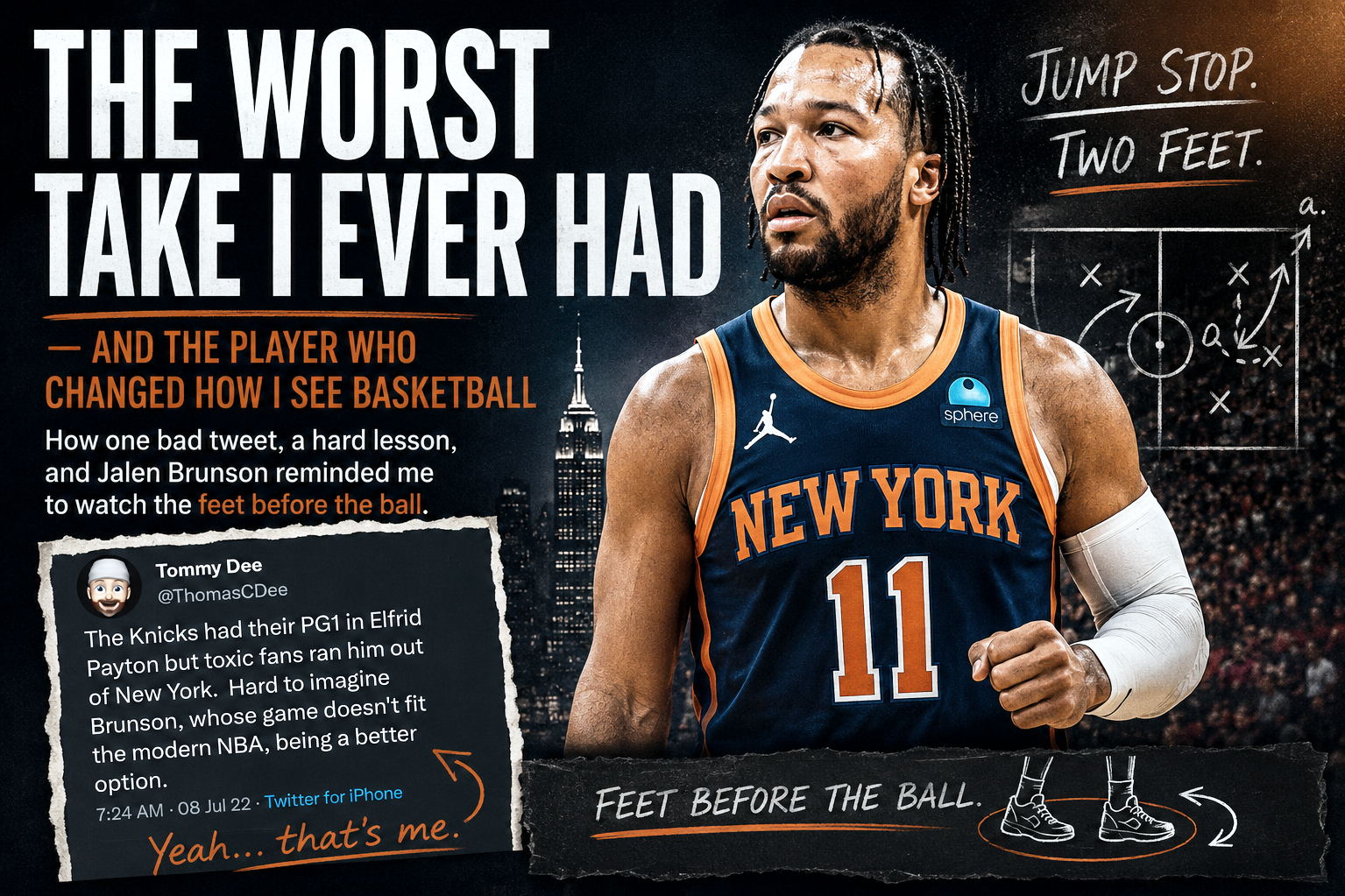
I can see it now, once a year, my phone buzzes with the same screenshot.
Sometimes it's a friend who thinks he's the first person to send it to me. Sometimes it's a random reply on X from someone who just discovered my existence. Every once in a while it gets picked up by one of those engagement-farming sports sites that knows exactly what it's doing—pull a four-year-old tweet out of context, throw it in front of an audience of anonymous profile pictures, and watch the replies pile up.
That's the internet now.
Take one opinion, freeze it in time, remove every ounce of context, and let thousands of people who have never put a public opinion on the record decide you're an idiot.
The tweet?
It's this one. I call it “The Brunson Error”
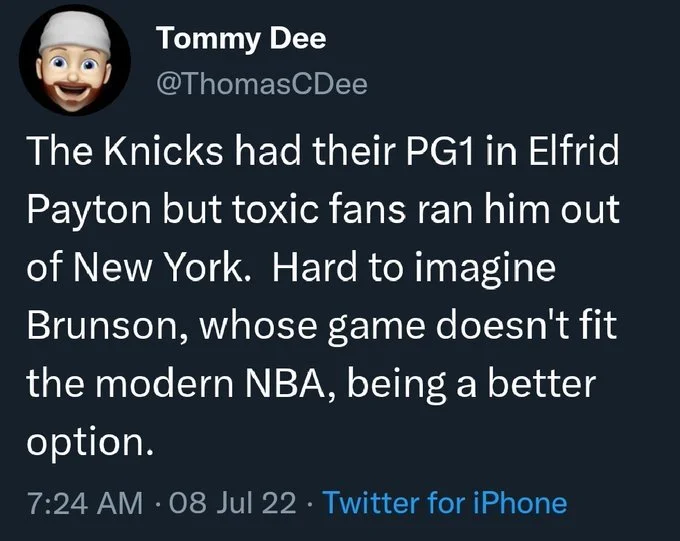
Yeah...
That's me.
Not exactly my finest moment.
The funny part is I had completely forgotten I even wrote it.
I wasn't sitting around defending it. I wasn't secretly hoping history would prove me right. If you had asked me six months before someone resurfaced it, I honestly don't know if I could have told you it existed.
Then my phone started buzzing.
Again.
And again.
And again.
Apparently there are people whose full-time hobby is making sure sports fans never escape the worst opinion they've ever had. In fairness, @OldTakesExposed has built an entire brand around that idea, which is an odd way to try to put your kids through college.
Honestly?
Good.
Leave it up.
Don't delete it.
Keep tagging me.
Because somewhere along the way, that tweet stopped being embarrassing and started becoming important. Not because it reminds me that I was wrong.
Every evaluator is wrong.
Every scout misses.
Every analyst has predictions they'd love to have back.
That's part of the job.
What makes this one different is why I was wrong.
Looking back, I don't think I misunderstood Jalen Brunson.
I misunderstood the power of Villanova basketball. I and I should have known better. No one was louder about the Knicks drafting Mikal Bridges after the Wildcats championship run than yours truly.
Of course, you won’t see the stalkers of old takes share those out.
Why I Thought What I Thought
Let's rewind to the summer of 2022.
Today it's easy to pretend Brunson was an obvious superstar and everyone saw this coming.
They didn't.
The Knicks were coming off a disappointing season after the surprising run in 2020-21. Julius Randle had regressed from his All-NBA campaign. Kemba Walker hadn't worked. Derrick Rose couldn't stay healthy. The offense felt stuck, and every possession seemed harder than it needed to be.
They needed a point guard.
Everyone agreed on that.
The debate was whether Jalen Brunson was that point guard.
Brunson was undeniably a good player in Dallas. Tough. Efficient. Smart. One of the best backup-turned-starter stories in the league.
But he had also spent most of his career next to Luka Dončić.
That's an important detail because playing next to Luka changes the way people evaluate you.
Every possession begins with Luka.
Every defense is built around Luka.
Every advantage starts with Luka.
So when Brunson played well, I convinced myself I was mostly watching someone benefiting from Luka's gravity instead of someone capable of creating gravity himself.
That's where I made my first mistake.
I confused role with ability.
Just because a player has been asked to do one thing doesn't mean that's all he's capable of doing.
Sometimes context hides greatness instead of revealing it.
I didn't appreciate that then.
The Bigger Mistake
Looking back, though, Luka wasn't really why I missed.
The bigger problem was the framework I was using to evaluate players in the first place.
Without realizing it, I had become obsessed with archetypes.
I had a picture in my head of what a modern NBA point guard was supposed to look like.
Explosive first step.
Pull-up three.
Elite vertical athlete.
Constant downhill pressure.
Unlimited range.
Play fast.
Play above the rim.
Pressure the paint with speed.
Brunson wasn't that guy.
He wasn't blowing by defenders.
He wasn't living 30 feet from the basket.
He wasn't throwing down highlight dunks.
He wasn't six-foot-six with a seven-foot wingspan.
So I looked at everything he wasn't instead of studying everything he actually was.
And that's the trap.
It's easy to evaluate players against an imaginary template.
It's much harder to evaluate the player standing in front of you.
Somewhere along the way, I had stopped asking,
"What makes this player special?"
Instead, I was asking,
"Why doesn't he look like the last superstar?"
Those are completely different questions.
One leads to discovery.
The other leads to blind spots.
About a Half of Basketball
I wish I could tell you there was some long, thoughtful evolution.
There wasn't.
It took about a half of basketball.
I don't even remember the exact possession.
Maybe it was one of those post-ups where Brunson backed a bigger defender down before spinning into a left-handed finish.
Maybe it was one of those possessions where he got into the lane, stopped on two feet, pivoted three different times, waited for everyone else to lose their balance, and calmly scored.
Whatever it was, I remember thinking something I hadn't expected to think.
"Oh...I completely missed this."
Not six months later.
Not after an All-Star appearance.
Not after a playoff run.
About a half.
And what struck me wasn't that Brunson was better than I expected.
It was that he was exactly what the Knicks had been missing for years.
For the first time in what felt like forever, every possession looked organized.
The offense had rhythm.
Julius Randle didn't have to initiate everything.
The game slowed down.
Nothing felt rushed anymore.
Brunson wasn't dominating the ball because he wanted statistics.
He was controlling the game because someone finally could.
Watching him, I realized something I should have recognized years earlier.
The hardest thing to find in basketball isn't athleticism.
It's control.
And I had spent years undervaluing it.
That realization changed everything.
Not just how I thought about Jalen Brunson.
How I thought about basketball itself.
Because once I started asking different questions, I started seeing entirely different players.
And that's where this story really begins.
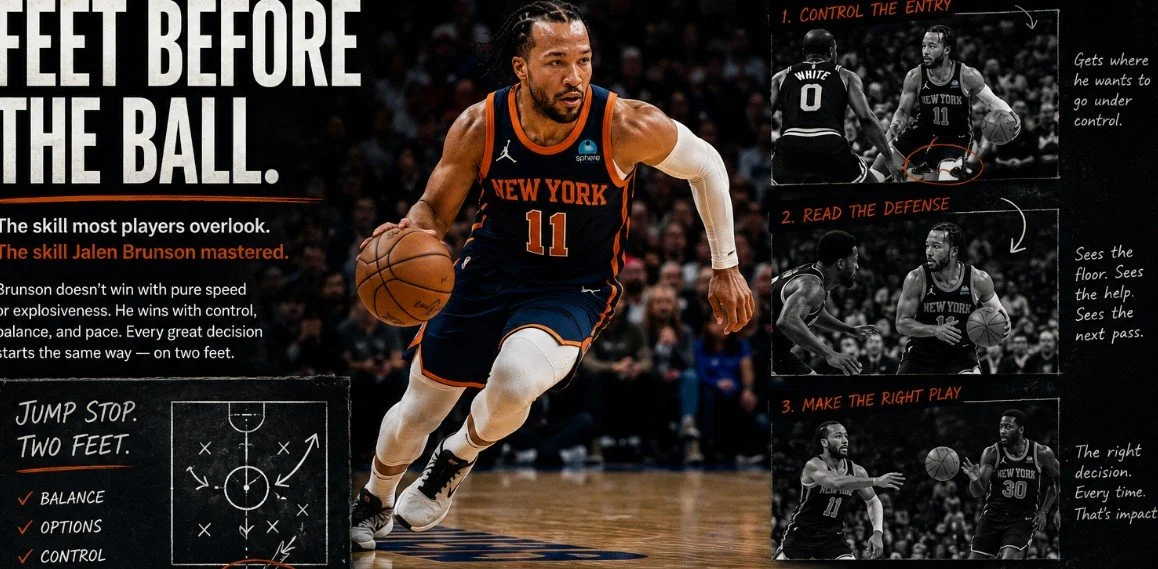
Part 2: Feet Before the Ball
One of the funny things about getting older is realizing your coaches were right long before you understood why.
Growing up, we didn't call it "playing off two feet."
We called it jump stopping.
If you played for Jim Avery—or later Mike O'Donnell—you probably heard the same phrases a thousand times.
"Jump stop."
"Two feet."
"Be under control."
Every drill seemed to end the same way.
Sprint.
Catch.
Jump stop.
Pivot.
Pass.
Reverse pivot.
Finish.
As a kid, I understood how to do it.
I had no idea why it mattered.
Like every young player, I wanted to play fast. I wanted to score. I wanted to make the spectacular play. Meanwhile, Coach Avery—and later Coach O'Donnell—kept stopping practice to talk about balance.
At the time, it felt obsessive.
Looking back, it was foundational.
They weren't teaching us how to stop.
They were teaching us how to think.
A jump stop isn't about ending a play.
It's about refusing to end your options.
When you land on two feet, you haven't committed yourself. You can pivot. Pass. Shoot. Reset. Read the defense one more time. The possession is still yours.
The player under control almost always has one more answer than the defender expects.
I understood the drill.
I didn't understand the lesson.
Not until I watched Jalen Brunson.
The first thing that stood out wasn't his scoring.
It wasn't the footwork everyone loves to post on social media.
It was the control.
Every time Brunson got into the paint, he stayed balanced.
He never seemed rushed.
He never looked like he was trying to outrun the game.
He arrived under control, let the defense reveal its intentions, and then made the right decision.
Sometimes that decision was a left-handed finish.
Sometimes it was a pivot.
Sometimes it was a kick-out.
Sometimes it was simply waiting an extra half-second for the play to develop.
Watching him, I realized something I'd spent years overlooking.
Control is a skill.
Patience is a skill.
Deceleration is a skill.
Balance is a skill.
Some of the greatest athletes in basketball aren't the ones who move the fastest.
They're the ones who know exactly when not to.
That realization changed the way I saw athleticism.
For years, I'd treated athleticism as something explosive—vertical leap, first step, speed in the open floor.
Brunson forced me to broaden that definition.
The ability to stop is just as valuable as the ability to accelerate.
The ability to stay balanced through contact is just as important as the ability to create separation.
The ability to process a possession one beat longer than everyone else might be the rarest athletic trait of all.
Funny enough, none of that was new.
I'd heard it before.
In an old high school gym.
From two coaches who kept yelling the same three words.
"Jump stop."
"Two feet."
It just took me a few decades—and one point guard from New York—to finally understand what they meant.
Part 3: The Blind Spot Jalen Brunson Exposed
Once I admitted I'd missed on Brunson, I started asking myself a question that was honestly a little uncomfortable.
If I could miss this badly, what else was I missing?
That's a dangerous question for anyone who evaluates players.
It's also the most important one.
Because if your first instinct after being wrong is to defend yourself, you've stopped learning. But if your first instinct is to examine the framework that produced the mistake, then being wrong becomes one of the most valuable things that can happen to you.
I wasn't interested in explaining away the Brunson take.
I wanted to understand why my process failed.
The answer wasn't that I had ignored the numbers.
It wasn't that I hadn't watched enough games.
It wasn't even that I'd underestimated Brunson.
The answer was simpler.
I had become obsessed with identifying stars.
I wasn't spending enough time identifying basketball players.
There's a difference.
For years, basketball conversations have revolved around ceilings.
What's his upside?
Can he become an All-Star?
Can he become an MVP?
Can he become the face of a franchise?
Those are important questions.
But somewhere along the way, I realized they're often the wrong ones.
Championship teams aren't built with fifteen stars.
They're built with players who solve problems.
Every player on the floor is answering a different question.
Who organizes the offense?
Who protects the rim?
Who rebounds in traffic?
Who can survive a switch?
Who keeps the ball moving?
Who creates something when the play dies?
Who makes everyone else better?
Brunson wasn't just answering one of those questions.
He was answering several at once.
That's much harder to measure than points per game.
It also changed how I think about "hidden gems."
When people hear that phrase, they usually think it means finding the next superstar before everyone else.
I don't.
To me, a hidden gem is someone whose value hasn't been fully explained by the current conversation.
Sometimes that's because the numbers haven't caught up.
Sometimes it's because the role hasn't caught up.
Sometimes it's because we're looking for the wrong things.
Brunson wasn't hidden because nobody knew he was good.
He was hidden because too many of us—including me—were evaluating him through someone else's lens.
We were asking whether he looked like the prototype instead of asking whether he consistently drove winning.
Those are very different exercises.
That realization eventually became one of the foundations of the work I do today.
People ask me about MSR all the time.
They assume it's about creating one magic number that tells you who can play.
It's not.
MSR was born out of curiosity.
I wanted a framework that rewarded the traits traditional conversations often overlook.
Decision-making.
Processing speed.
Role scalability.
Basketball IQ.
Balance.
Adaptability.
The ability to create advantages that don't always show up in a box score.
The ability to make the player next to you better.
Because here's the thing.
The NBA has gotten incredibly good at measuring what happened.
We're still getting better at measuring why it happened.
Brunson also changed how I think about building teams.
When fans evaluate a roster, they usually start with talent.
How many stars?
How many scorers?
How many shooters?
I think the better question is:
What ecosystem are you creating?
Every great player changes the value of everyone around him.
Steph Curry makes shooters more dangerous because defenders refuse to leave him.
Nikola Jokić turns cutters into weapons.
Luka manufactures open threes.
Brunson does something a little different.
He gives everyone clarity.
Watch the Knicks when Brunson is healthy.
The offense doesn't feel rushed.
Players know where their shots are coming from.
The big knows when to screen.
The weak-side wing knows when the rotation is coming.
The possession has shape.
That's leadership.
Not the kind you hear about in interviews.
The kind you feel every possession.
I think that's why I've become much more interested in complementary basketball than fantasy basketball.
Fantasy basketball asks:
"How many points did he score?"
Winning basketball asks:
"How many problems did he solve?"
Those aren't always the same player.
The older I get, the more I appreciate players who quietly remove friction.
The connective tissue guys.
The players who make the game easier without demanding credit.
Brunson happens to score thirty while doing it.
Many others don't.
But the principle is the same.
Every championship team is filled with players who make someone else's job easier.
I don't think I appreciated that enough ten years ago.
I definitely didn't appreciate it in 2022.
I do now.
Ironically, that's what made the old tweet one of the best things that ever happened to me as an evaluator.
Not because getting roasted on the internet is fun.
It's not.
Trust me.
But because every time someone reposts it, it reminds me of something important.
Don't fall in love with archetypes.
Don't assume you've solved basketball.
Don't confuse aesthetics with impact.
And never stop asking whether the framework itself needs to evolve.
Basketball keeps changing.
The players keep changing.
If your evaluation process isn't changing with them, eventually you'll become the guy defending a four-year-old tweet instead of learning from it.
I'd much rather be the second guy.
Because Jalen Brunson didn't just become the best free-agent signing in Knicks history.
He became the player who permanently changed the way I evaluate basketball.
And honestly, I think that's a pretty good return on one terrible tweet.
Part 4: Building a Better Framework
One of the unexpected things about changing the way you think is that it rarely stays confined to one moment.
Once Jalen Brunson forced me to question my evaluation process, I couldn't go back to watching basketball the same way.
Every game became a chance to test a different set of questions.
What actually translates to winning?
Which skills age well?
What do we consistently overlook because they don't fit the prototype?
Eventually, those questions became projects.
This summer, I found myself spending nights building a live Summer League scoreboard—not because I wanted another leaderboard, but because I wanted a different conversation.
The box score already tells us who scored twenty-five.
Social media already tells us who had the highlight dunk.
I became much more interested in the players who quietly made every possession better.
The guard who never sped himself up.
The wing who always made the extra pass.
The big who created three good possessions without ever touching the ball.
The connective tissue.
The players who make winning easier.
That's why I started creating Hidden Gems.
Not to claim I'd discovered the next superstar.
Quite the opposite.
To force myself—and hopefully other people—to look beyond the obvious.
To ask better questions.
Sometimes the hidden gem isn't hidden because nobody knows who he is.
He's hidden because we're all looking in the wrong direction.
When I built the Summer League dashboard, I realized something.
The exercise wasn't really about ranking players.
It was about challenging my own biases.
Could I identify the player who consistently solved problems before the box score caught up?
Could I recognize someone who processed the game a half-second faster than everyone else?
Could I reward decision-making as much as raw production?
In a strange way, the project wasn't really about Summer League at all.
It was about making sure I never repeated the Brunson mistake.
That's probably the biggest lesson I've taken away from all of this.
Most people think evaluation is about finding the right answers.
I don't anymore.
I think it's about asking better questions.
The answers change.
The league changes.
Players change.
If your framework isn't changing too, eventually you'll stop seeing what's right in front of you.
Mine almost did.
Thankfully, Jalen Brunson—and a few coaches yelling "Jump stop!" decades earlier—didn't let it.
Looking back, that's probably why I found myself building things like the Summer League leaderboard and the Hidden Gems project. On the surface, they're about evaluating players. In reality, they're about evaluating myself. Every prospect, every Summer League game, every "hidden gem" is another chance to test whether I've actually learned the lesson Jalen Brunson taught me. Am I still chasing prototypes? Or am I recognizing the players who quietly make winning easier?
Funny enough, every few months my phone still buzzes with that old screenshot.
It doesn't bother me anymore.
In fact, I'm grateful for it.
Because it reminds me that the goal was never to become someone who never misses. It was to become someone whose process keeps getting better.
The tweet captured who I was as an evaluator in 2022.
The work I've done since—the scoreboards, the Hidden Gems, the frameworks, and the questions I ask every time I watch a game—is my attempt to make sure I never stop evolving.